
How to Structure Retail Incentive Rewards: Cash, Product, Tiers, and Prizes
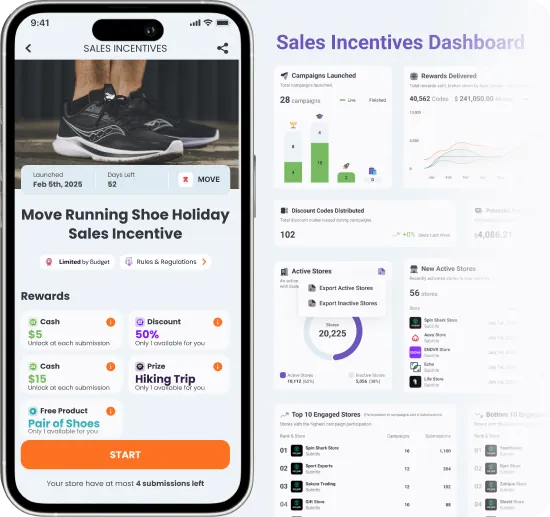
Two brands run sales incentives with the same budget, at the same stores, on similar products. One gets a burst of claims in week one that fades by week three. The other has associates checking their tier progress in the break room in week ten.
Budget rarely explains that difference. Structure decides how long a program holds the floor's attention. This guide covers how to choose reward types and build reward structures for retail incentive programs, drawn from campaigns across 15,000+ stores on ENDVR. If you're starting from zero, our SPIFF program guide covers the full campaign process; this one goes deep on the reward itself.
Match the reward type to the job
There is no single best reward. Cash, product, and discounts each do a different job, and the strongest programs use more than one.
Cash: fast to launch, universally valued. Cash is the easiest reward to run and the easiest for an associate to understand, which is why it's the right base layer for almost every program. No coordination with your warehouse, no sizing questions, no unclaimed inventory. When your goal is to get a program live this week and prove the model, cash per verified sale is the move. Its one limitation: a cash payout is spent and forgotten. It buys action, and it buys less memory.
Product: deeper brand connection. Product rewards take more coordination, and they do something cash can't. An associate who earned your jacket wears it on the sales floor, which makes them a walking recommendation. And earned product carries a story: nobody tells a coworker about the extra $10 they earned this week, but the associate who worked their way to a snowboard tells everyone. In enthusiast categories, the product itself is often the strongest motivator you have.
Discounts: a deepener for associates already sold on you. Discount codes ask the associate to spend their own money, so they only motivate the ones who already want your product. That's a real limitation and a real signal at the same time: the associates who buy through their discount are wearing your brand by choice, and they're typically among your most engaged advocates. Discounts work as a relationship layer on top of a program. They rarely work as the engine of one, which is worth remembering when evaluating advocacy programs where a pro discount is the entire offer.
The structures that drive the most engagement
Reward type sets the value. Structure is what sustains the effort, and across our network the pattern is consistent: sell-X-get-Y milestones and multi-tier ladders outperform flat per-sale rewards on engagement, week after week.
A layered program looks like this:
- Base: cash on every verified sale, paid instantly. This keeps every associate in the game from sale one.
- Milestones: sell-X-get-Y steps that escalate. Sell 5, earn a bonus. Sell 15, earn product. Each tier gives the associate a next thing to chase.
- Grand prize: something worth talking about for the top seller, or the top few.
The tier chase is the point. One watch brand ran four reward tiers, and the associates working toward the $800 watch at the 40-unit mark kept selling long after a flat reward would have faded into the background. One winter brand put snowboards in the hands of its 50 top sellers at season's end, and those boards seeded the next season's participation better than any launch announcement.
Flat rewards plateau because each sale earns the same forgettable amount. Ladders compound because every sale moves the associate closer to something they actually want.
Give the whole floor a reason to care
Individual rewards can create a quiet problem: one strong seller runs the board while the rest of the floor tunes out. Two structures counter it.
Store-level goals. A shared target ("if this store hits 100 verified sales, everyone earns X") aligns the whole team, gets your program mentioned at the morning huddle, and turns your strongest seller into a coach instead of a competitor.
Visible races. Leaderboards and grand prizes give associates who won't finish first a race worth watching, and the winner's prize becomes a story the whole store retells. That retelling is how a brand's program becomes part of a store's culture rather than a line item in an app.
Keeping your veterans engaged
Your most engaged associates behave differently. Once someone is selling your product habitually, the exact reward math matters less to them than it did on day one. What keeps them engaged is variety: a raffle entry per verified sale with a few large prizes, a seasonal grand prize, early access to new product, an invitation to a brand event.
This is useful budget news. Keeping the program interesting moves your best people more than escalating per-sale payouts ever will. Save the escalation for the middle of your ladder, where an associate deciding whether to push for tier three is exactly the person a better tier-three reward moves.
Why reward flexibility matters
Every structure above assumes you can actually mix reward types, and that's worth checking before you commit to any incentive vehicle. Discount-only models, common among advocacy programs, can only reach the associates who already want the product. A program that can pay cash, ship product, offer discounts, and run tiered prizes meets every associate where they are: cash for the associate who wants earnings, product for the enthusiast, a discount for the loyalist, and a grand prize for the competitor.
ENDVR supports all of them in a single campaign, with every claim verified by receipt, which is what lets you see exactly which structure drives sell-through in which doors (how we verify).
Timing the structure to the season
Match the ladder length to the selling window. A four-tier ladder is right for a 10-week season; it's wrong for a 3-week push, where a flat reward plus one prize is cleaner. And end programs while they're still interesting. A ladder that runs indefinitely becomes wallpaper, and a floor that watched a program end on a high with a winner's story is primed for the next one.
Pair the structure with education timed four to six weeks before the season, which is when the recommendation conversations start. The sequencing evidence and the mechanics are in our associate education playbook and the sell-through playbook.
Frequently asked questions
How much should the base reward be per sale? It varies with price point and margin; the average reward across the ENDVR network is $5 per verified sale, and brands average $26 in sell-through per $1 in rewards (methodology). Start where the reward feels meaningful for the effort of the sale, then let your tier structure carry the ambition. The ROI calculator shows how any reward level converts a budget into units and verified sales.
Should rewards be cash or product? Both, doing different jobs. Cash gets the program live and keeps every associate in the game. Product builds the deeper connection and carries the stories. Most strong programs use cash as the base and product in the upper tiers.
How many tiers should a program have? Three or four covers most programs: a base reward, one or two milestones, and a grand prize. More than that and associates stop tracking where they are.
Do discounts count as incentive rewards? As a layer, yes. On their own, rarely. A discount only motivates an associate who already wants the product and is willing to spend for it. Pair discounts with cash or product rewards so the program reaches the whole floor, then treat discount redemptions as a signal of who your true advocates are.
Ready to build a program associates chase all season? Launch your first incentive, or talk to a sell-through expert about the right structure for your category.
Ready to transform your retail strategy?
See how ENDVR can help you engage frontline retail teams and power sales.