
The Wholesale Tech Stack: Connecting Sell-In to Sell-Through
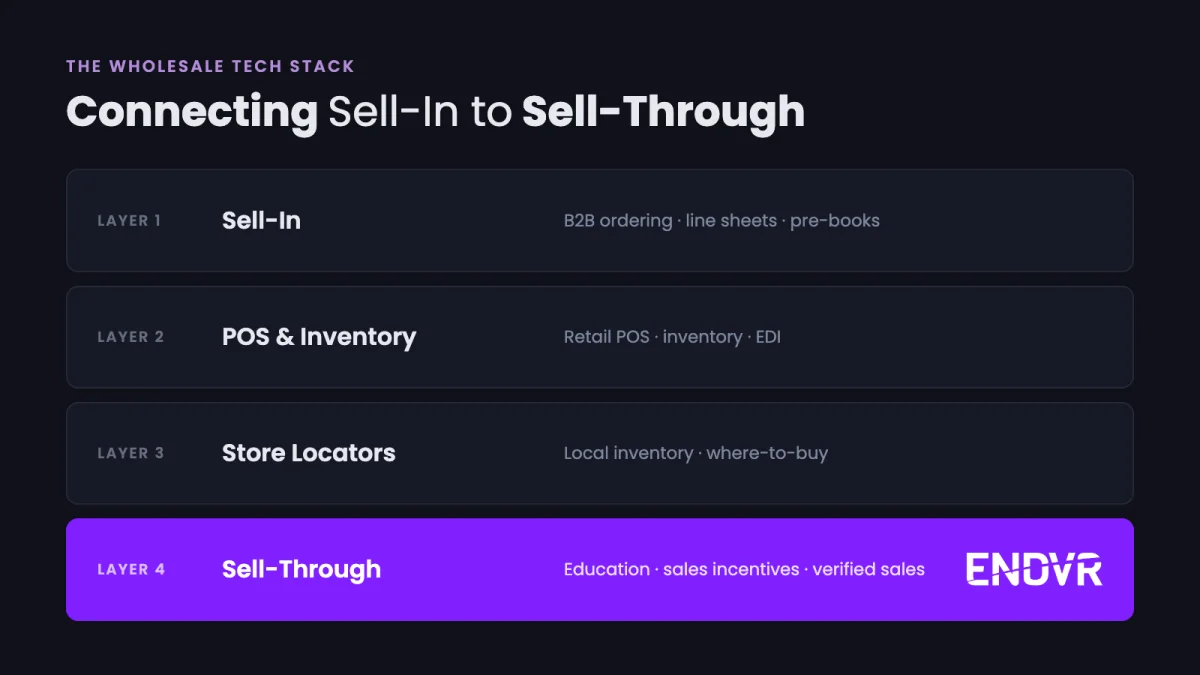
Ask a wholesale brand what's in their tech stack and you'll usually hear about one tool: the B2B ordering platform where dealers place their pre-books. NuORDER, JOOR, Elastic Suite: pick your category's favorite.
That's one layer. A working stack has four.
The brands that consistently win re-orders run a stack that follows the product all the way from the showroom to the shopper's hands. It has four layers, and most brands only have the first one.
Layer 1: Sell-in (taking the order)
This is the layer everyone has. A B2B ordering platform digitizes your catalog, your line sheets, and your order capture. Buyers browse, build assortments, and place pre-books; your team sees the order book in real time.
The market leaders each own a territory: JOOR in fashion, Elastic Suite in outdoor and sporting goods, NuORDER across general retail, Brandboom for emerging brands, Brandscope in Australia and New Zealand, RepSpark in rep-driven categories like golf. We compare all of them in our guide to the best B2B wholesale platforms.
What this layer tells you: exactly what every dealer bought, down to the SKU.
What it can't tell you: whether any of it sold.
Layer 2: POS and inventory (where the sale gets rung up)
The second layer belongs to your retailers: their POS and inventory systems. Lightspeed, Shopify POS, and the long tail of specialty retail systems record every transaction, including yours.
For a handful of your biggest accounts, some of that data flows back to you through EDI or vendor portals. For everyone else, it stays locked in the store. Most brands have sell-through visibility into fewer than 10% of their doors, which means the majority of the order book from Layer 1 disappears into a reporting void the moment it ships.
The difference between sell-in and sell-through is the difference between what Layer 1 records and what Layer 2 knows. The distance between those two numbers is where wholesale seasons quietly fail.
Layer 3: Store locators and local inventory (directing demand to the door)
The third layer points shoppers at the stores that stock you. Tools like Locally put live local inventory on your brand site, so a shopper researching your product at 11pm finds the dealer two miles away that has it on the wall, instead of drifting to a marketplace.
This layer matters more than it looks. Every shopper it sends into a store is a sale that lands in your dealers' registers, strengthens the partnership, and (unlike a DTC sale) makes your next pre-book conversation easier.
What this layer tells you: where consumer demand is pointing.
What it can't do: influence what happens once the shopper is standing at the shelf, talking to an associate.
Layer 4: Sell-through enablement (moving product off the shelf)
The last layer works the sales floor itself. In specialty retail, the associate's recommendation decides more sales than any other factor, and that recommendation goes to the brand the associate knows, likes, and has a reason to sell.
Sell-through enablement puts your brand education, sales incentives, and product stories directly on the phones of the associates in every door you sell. On ENDVR, an associate learns your product line in a few spare minutes, earns cash for every verified sale, and every AI-verified receipt becomes a sell-through data point from a store that will never send you EDI. Brands on ENDVR average $26 in verified sell-through per $1 in rewards, and the ROI calculator will model what that looks like for your network.
This is also the layer that closes the visibility loop Layer 2 leaves open: instead of waiting for EDI feeds that mostly don't exist, the verified receipts flowing through your incentive programs show you what's selling, where, this week, across the whole network. Our guide on how to improve sell-through in retail breaks down the three levers that move the number.
How the layers work together
A season through a complete stack looks like this:
- Pre-book season: dealers build orders in your B2B platform (Layer 1). You know exactly what shipped where.
- Launch week: associates in every door get your product education and a launch incentive (Layer 4), so the people selling your product can speak to it from day one.
- In season: consumer demand routes to stocked dealers (Layer 3), associates recommend and sell (Layer 4), and verified receipts show you sell-through by store and product in real time.
- Re-order season: you walk into the buyer conversation with store-level proof of what sold, instead of hoping the buyer's numbers look good.
The brands that struggle in wholesale usually aren't missing effort. They're missing layers: running a great sell-in motion and then going dark for six months until the re-order tells them how the season went.
Where to start
If you only have Layer 1, don't start by adding more ordering features. Start where the visibility ends: the sales floor. Sell-through enablement is the fastest layer to add, and the one that makes every other layer measurable. ENDVR is free to start, live in minutes, and the first $5,000 in verified sales costs nothing.
Ready to transform your retail strategy?
See how ENDVR can help you engage frontline retail teams and power sales.