
How to Train Retail Sales Associates: A Playbook for Brands
Most advice on training retail associates is written for retailers: onboarding checklists, POS procedures, customer service scripts. Useful, if you employ the associates.
Brands face a harder version of the problem. The people selling your product work for someone else, across dozens or hundreds of stores, with turnover that can clear half the floor in a year. You can't schedule them into a session, you can't mandate a course, and your brand sales rep sees each door a handful of times a season. This playbook is for that version: brand education for a sales floor you don't control.
Why associate knowledge is worth a brand's investment
In considered categories (footwear, outdoor gear, electronics, sporting goods, beauty), customers ask the associate. The recommendation frequently decides the sale, and associates recommend what they can explain with confidence.
The difference is measurable. An associate who can compare your product to the two next to it sells more of it, at higher attachment rates and higher average selling price, than one who can only confirm it's in stock. Dragon Alliance saw associates move customers up from entry models after education plus incentives, lifting average selling price by $33 (case study).
The knowledge decays constantly: seasonal hires arrive every quarter, assortments change twice a year, and every other brand in the store is competing for the same attention. Education for the wholesale channel is a rhythm that repeats every season, and it pays to keep a core of evergreen content live between seasons: brands that keep a light off-season rhythm start the season warmer.
What to teach: the shape of a recommendation
The binder era failed partly on delivery and partly on content. A features list doesn't survive to the sales floor. What survives is the shape of a recommendation, and every module you produce should hand the associate one:
Who it's for. "This boot is for the skier who does 30+ days a year and wants one setup for everything." Customer-matching is the associate's core skill; give them the match.
What makes it different. Not different in general, different from the two products beside it on the wall, including your competitors'. Honest comparisons earn more floor-time than superlatives.
The one line that closes. The sentence an associate can say to a hesitating customer. "It's the only one in this price range with a lifetime warranty" outsells four paragraphs about materials.
What it's not. Telling associates who shouldn't buy your product builds more credibility than any claim about who should. Credibility is the currency of the recommendation.
One product family per module; a full catalog dump is a reference document.
How to deliver it: meet the floor where it works
Phone-first, always. The associate's device is in their pocket on the sales floor. Desktop courses assume a back-office computer and a quiet hour; neither exists in retail.
2 to 4 minutes per module. Education happens between customers. Completion data is unambiguous on this: retail learning tools built around long courses routinely see completion under 50%, while 2-4 minute rewarded modules average 89% completion on ENDVR. The format is most of the outcome.
Reward completion. You're asking for attention the associate could give to six other brands or their own break. Cash or product rewards for completed modules respect that math, and they're why associates come back for your next release.
Quiz for understanding, gate for eligibility. A short quiz confirms the content landed. Some brands go further and make education completion the eligibility gate for sales incentives on the same SKUs, which sequences knowledge before motivation.
Time it to the season. Publish four to six weeks before the category conversation starts in stores. Education that lands off-season is forgotten by the time a customer asks.
The multiplier: education plus incentives
Education tells the associate what to recommend. An incentive gives them a reason to recommend yours today. The two together are the strongest pattern we see across the network: brand education on a SKU, followed by a verified-sale incentive on the same SKU.
The logic is simple: knowledge without motivation gets your product mentioned when convenient, and motivation without knowledge gets an unconvincing pitch. Across the ENDVR network, stores that engage with both a brand's education and its incentives stay engaged at roughly 68%, against 39 to 45% for a single campaign type. Participating brands average a 41% same-store sales increase against matched control stores, and WPS earned $72 in sell-through per $1 invested running exactly this sequence across 837 dealers (case study).
The mechanics of the incentive half are covered in how to run a SPIFF program in retail.
Measuring whether it moved product
Completion rate is only the checkpoint. The chain worth tracking:
- Reach: what share of associates in your doors started the module
- Completion and quiz scores by store and region
- Sell-through change on covered SKUs, same-store, against doors you didn't educate
That third number is the one your leadership cares about, and it requires connecting education data to sales data. This is the structural advantage of running education and verified-sale incentives in one place: when an associate completes your module and later submits a receipt for the same SKU, the line from investment to sell-through draws itself.
Store-level comparisons also diagnose your network. When educated doors outsell uneducated ones three to one, you have a scaling argument. When they don't, you've learned your content needs work before you put money behind it, which is cheaper to learn early.
Working with the retailer
Store managers decide whether your program gets floor talk-time. The programs that thrive treat the manager as a stakeholder: tell them what you're running and why it makes their team money, share which content their team completed, and recognize their top performers. A manager who sees your brand making their team sharper and better paid becomes your advocate at zero cost.
The strongest opening move is to bring the manager through the education first. A manager who has completed your modules before the team joins knows exactly what they're endorsing, and their invitation carries more weight on the floor than any brand announcement.
Some large retailers run their own learning systems and ask brands to publish through them. Do it for those doors, and reach the rest of your network directly. The two channels cover different territory, and most of the specialty and independent doors that drive sell-through in enthusiast categories are only reachable brand-direct.
Where to start
Pick your five most important SKUs for the coming season. Build one module per product family: who it's for, what makes it different, the one closing line. Publish six weeks before the season to the doors that carry them, reward completion, and follow two weeks later with a verified-sale incentive on the same SKUs. Measure same-store sell-through against the doors you didn't touch.
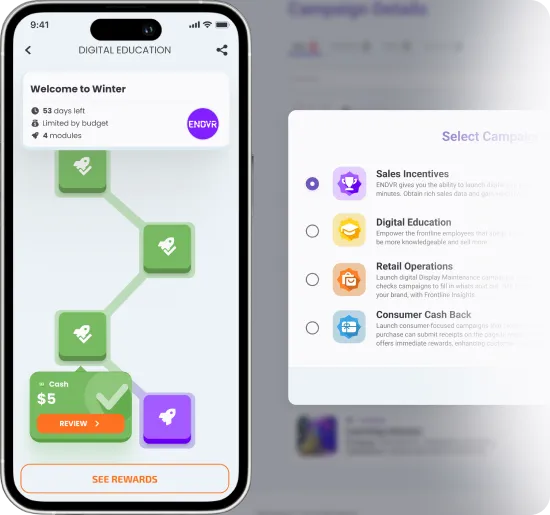
That full sequence runs from one portal on ENDVR, education through Digital Education and incentives through Sales Incentives. Your first stores on ENDVR are free, so a pilot on your key doors costs you the content and the rewards, nothing else. Get started or talk to a sell-through expert.
Ready to transform your retail strategy?
See how ENDVR can help you engage frontline retail teams and power sales.