
The 8 Best Sales Incentive Platforms for Retail Brands in 2026
If you searched for a sales incentive platform, you found two very different categories wearing the same name.
The first category manages commission plans for your own sales team. Salesforce Spiff, CaptivateIQ, and Everstage live here. They calculate quotas, automate payouts, and keep finance happy.
The second category rewards the retail associates who sell your products in stores you don't own. This is where brands selling through wholesale live, and it works differently: the people you're rewarding don't work for you, the sales happen at your retail partners, and proving a sale actually happened is the hard part.
Full disclosure before we go further: we build ENDVR, one of the tools on this list. We've kept the comparisons factual and sourced each claim from the vendors' own materials, because an honest map of the category earns more trust than a rigged one.
The short version
| Tool | Built for | Sale verification | Best fit |
|---|---|---|---|
| ENDVR | Brands rewarding associates across wholesale networks | AI receipt scanning on every claim | Brands in sporting goods, outdoor, footwear, electronics selling through dealers |
| SparkPlug | Retailer- and brand-funded incentives at POS-integrated stores | POS integration | Cannabis, restaurant, and general-retail teams on connected POS |
| Salesforce Spiff | Internal sales team commissions | CRM data | B2B sales orgs managing comp plans |
| Rallyware | Enterprise workforce performance | Integrated data feeds | Large retailers, direct-selling companies, and brands via Myagi by Rallyware |
| ExpertVoice | Pro deals, packaged as advocacy and reviews | No sale required — status opens the deals | Brands trading discount margin for review volume and seeding |
| SPARC Retail | Brand-to-associate engagement | Self-reported | Sports and outdoor brands wanting lightweight engagement |
| Outdoor ProLink | Pro deals for outdoor professionals | Purchase through their site | Outdoor brands reaching guides and instructors |
| Awardco | Employee recognition and rewards | HR system data | Companies rewarding their own employees broadly |
1. ENDVR
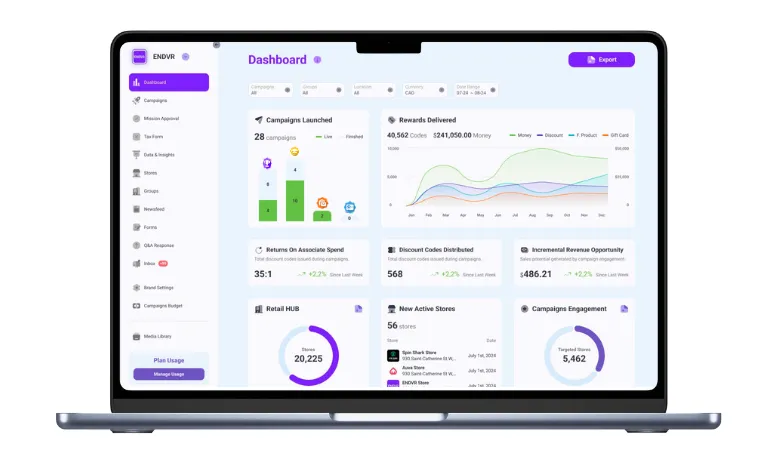
ENDVR rewards retail sales associates for verified sales of your products across your entire dealer network. An associate sells your product, snaps a photo of the receipt, and ENDVR's AI confirms the product, store, date, and amount before the reward pays out instantly.
That verification step is the core difference. Incentives tied to confirmed receipts mean you invest in results, and the reporting reflects real sell-through rather than sign-ups or self-reported claims. Brands on ENDVR average $26 in sell-through for every $1 in associate rewards, measured across all active campaigns since January 2024 (methodology here).
Sales incentives also sit alongside brand education, market research, and display checks in the same app, so an associate who just finished your product education can act on it with a reward attached.
Reward flexibility is the other structural difference. ENDVR programs can pay cash, product, discounts, or tiered prizes in any mix, where advocacy models are limited to product discounts, which only engage the associates who already want the brand. Cash gets a program live fast, product rewards build deeper brand connection, and milestone tiers keep the floor selling all season.
Best for: brands selling through wholesale in sporting goods, outdoor, footwear, apparel, and consumer electronics.
Pricing: your first $5,000 in verified sales is free, then 3% per verified sale on Pay-As-You-Go, with volume rates for committed brands. Details on the pricing page, or model your own program.
Watch out for: if you need commission management for your own inside sales team, ENDVR is the wrong tool. It's built for the wholesale channel.
2. SparkPlug
SparkPlug runs sales incentives for frontline retail and restaurant teams, with deep roots in cannabis dispensaries and expansion into restaurants and general retail. It connects to the retailer's POS system, which gives it clean sales data without receipt submission, and it serves both sides: retailers incentivizing their own staff, and brands funding vendor-sponsored campaigns at retailers already on the platform.
The key structural constraint for a brand: campaigns depend on POS integration and retailer approval at each location. That works well inside SparkPlug's dense verticals like cannabis, and less well when your network is hundreds of independent specialty dealers running different systems, most of which aren't on the platform.
Best for: retailers incentivizing their own teams, and brands in cannabis or restaurant verticals where SparkPlug's POS coverage is dense.
Watch out for: coverage depends on which retailers have integrated and approved the program. Independent specialty dealers in outdoor and sporting goods are unlikely to be connected.
3. Salesforce Spiff
Salesforce Spiff (acquired by Salesforce in 2024, now sold as an add-on within Sales Cloud's Sales Performance Management suite) is incentive compensation management for internal sales teams. It automates commission calculations, models comp plans, and gives reps visibility into their earnings. It's excellent at that job.
It is not designed to reward third-party retail associates. If you landed here looking for a way to run SPIFF programs at your retail partners, this is the category confusion we mentioned at the top: same word, different job.
Best for: B2B sales organizations managing quota and commission complexity.
Watch out for: requires broader investment in Salesforce products to get full value.
4. Rallyware
Rallyware is an enterprise sales performance suite combining learning, incentives, communications, and task management, used by large direct-selling companies and retail enterprises. Since acquiring Myagi in 2023, it also sells to brands: "Myagi by Rallyware" delivers brand training to associates at third-party retailers.
For a brand, the incentive layer is the distinction to check: Rallyware's contests and challenges run on performance data from its customers' integrated systems; there is no independent per-sale verification. Where the retailer's data feeds exist, it's a capable enterprise system; across a fragmented dealer network, most doors have no feed to connect.
Best for: enterprises engaging a workforce they employ or contract, and brands whose key retailers are already Rallyware customers.
Watch out for: enterprise sales cycles, and incentives that depend on integrated data feeds most independent dealers can't provide.
5. ExpertVoice
ExpertVoice is, at its core, a pro-deal platform: 850,000+ verified "experts" — retail employees plus military, first responders, healthcare workers, teachers, and other credentialed groups — get product at up to 60% off by verifying their status. Most deals require no training and no sale. It packages this to brands as advocacy: the expert reviews and social content it syndicates to product pages are produced by the members receiving the discounts.
It's a fundamentally different transaction than a per-sale incentive: the discounted purchase happens through ExpertVoice's storefront, off the retail floor, and no confirmed retail sale is involved. That model has drawn public criticism from specialty retail — in 2021 the Grassroots Outdoor Alliance told vendors they "cannot coexist on ExpertVoice and in Specialty Retail as our business models are incompatible". We compare the two approaches in depth here.
Best for: brands that want review volume and product seeding across expert communities, and accept the discount economics that fund them.
Watch out for: pro-deal discounts of 30–60% flow to a broad member base with no sale required, and every pro-deal purchase is a sale that didn't happen at a retail partner — a tension your dealers may raise with you directly.
6. SPARC Retail
SPARC connects brands with retail associates in sports and outdoor, offering education modules and engagement campaigns. It's a lightweight way to get brand content in front of associates.
SPARC's analytics track training progress and engagement rather than sales — there's no per-sale tracking of any kind, which matters when you want to report ROI to a CFO. Our full comparison is here.
Best for: sports and outdoor brands wanting simple associate engagement with a hands-on services team.
Watch out for: rewards attach to learning activity with no verified-sales layer, so you can't tie the investment to sell-through.
7. Outdoor ProLink
Outdoor ProLink provides pro pricing (up to 50% off, 150+ brands) to verified outdoor professionals — guides, patrollers, instructors, athletes, and outdoor specialty retail employees — with a sister store, Pursuit Prolink, for hunting and fishing pros. It positions itself as the industry's most responsible pro program, with stricter vetting than broader pro-deal platforms.
Best for: outdoor brands seeding product with guides, instructors, and patrollers.
Watch out for: retail associates can join, but what they get is a personal discount on their own gear, with no reward attached to selling yours. A pro-deal fills the associate's closet; it doesn't give them a reason to recommend your product at the register. Full comparison.
8. Awardco
Awardco handles employee recognition and rewards, with sales incentives as one use case among many. It has a large reward catalog and solid HR integrations.
Like Salesforce Spiff, it's built for people on your own payroll. Brands selling through wholesale would use it for internal teams; the retail channel needs a different tool.
Best for: companies building recognition programs for their own employees.
Watch out for: not designed for third-party retail associates.
How to choose
Start with one question: whose sales behavior are you trying to change?
Your own sales team. Choose commission software: Salesforce Spiff, CaptivateIQ, or Everstage. Awardco if the goal is broader recognition.
Your own retail employees. SparkPlug if your POS is covered, Rallyware at enterprise scale.
Associates at retailers you sell through. This is the wholesale channel, and it's the specific job ENDVR was built for. Verification matters most here because you have no payroll relationship and no POS access at independent dealers. Receipts are what make your reporting defensible.
Experts and professionals who influence your category. ExpertVoice or Outdoor ProLink, often alongside a per-sale incentive program rather than instead of one.
If you're weighing an incentive program against doing it manually with spreadsheets and checks, we've written a comparison of ENDVR versus DIY incentive programs that covers when each makes sense. And if you're mapping the rest of your wholesale stack — the ordering platforms like NuORDER, JOOR, and Elastic Suite that handle sell-in — our guide to the best B2B wholesale platforms covers that side of the channel.
Frequently asked questions
What's the difference between a SPIFF and a sales incentive? A SPIFF (Sales Performance Incentive Fund) is a short-term reward for selling a specific product. Sales incentive is the broader term covering SPIFFs, contests, and ongoing reward programs. Our glossary entry on SPIFFs covers the history and mechanics.
How much should a brand budget for retail sales incentives? Reward size varies with price point and margin; the network average is $5 per verified sale. On ENDVR, brands average $26 in verified sell-through per $1 in rewards, so most brands start with a small pilot on key SKUs and scale based on measured return. The first $5,000 in verified sales is free, which makes the pilot itself no-risk.
Do retail associates actually participate in brand incentive programs? Participation follows reward value and ease. Programs that pay out instantly to an app the associate already uses see strong engagement; 140,000+ associates are active on ENDVR. Programs with paper claims and six-week checks struggle. Structure matters as much as size: milestone tiers and grand prizes keep associates selling long after a flat per-sale reward fades into the background. We cover how to structure incentive rewards separately.
Can I run incentives at retailers without POS integration? Yes. Receipt-based verification works at any store, which is why it fits wholesale networks with hundreds of independent dealers running different systems.
Ready to see what verified sell-through looks like across your dealer network? Launch your first incentive or talk to a sell-through expert.
Ready to transform your retail strategy?
See how ENDVR can help you engage frontline retail teams and power sales.